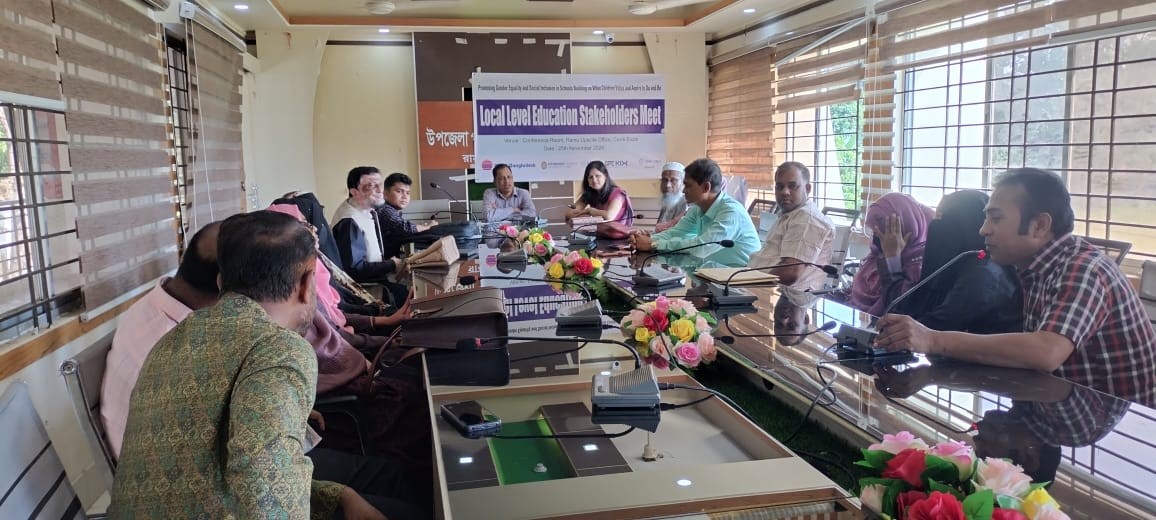
Narrative Report: Local-Level Education Stakeholders Meet
Project Name: Promoting Gender Equality and Social Inclusion in Schools Building on What Children Value and Aspire to Do and Be
Event Summary:
Reported By: Md. Nazmul Hossain
Name of the Program: Local-Level Education Stakeholders Meet
Milestone 2: Local Level Education Stakeholders Meet: Initial dialogues with local level key stakeholders (Personals of NGOs working with children, municipality heads, school headmasters, teachers, and parents)
District: Cox’s Bazar
Date of the meeting: 25th November 2024
Place: Conference room, Ramu Upazila Office
Number of participants: Total – 24 (Male: 15; Female: 09)
Chief Guest: Honorable Upazila Primary Education Officer, Ramu
Overview
RDRS Bangladesh hosted a Local-Level Education Stakeholders Meeting on 25 November 2024 in the conference room of the Ramu Upazila Office. This meeting brought together 24 participants, including local government, school headmasters, teachers, and parents. Nine were female, and 16 were male, reflecting diverse local-level perspectives on regional education.
The program commenced with an introduction to every participant. A research Associate from RDRS Bangladesh led an engaging presentation that introduced the organization’s work, explained GESI concepts in the Bangladeshi context, and shared relevant findings regarding local education. The presentation laid the groundwork for the discussions that followed, raising awareness about the role of local-level stakeholders in supporting gender equality and social inclusion.
A welcome speech by the Project Manager of RDRS Bangladesh, emphasizing the importance of collective action to improve education. The speech outlined the role of local stakeholders in fostering inclusive and equitable education for all children, particularly focusing on gender equality and social inclusion (GESI).
Guest Reflections
- Upazila Primary Education Officer:
-
- Stressed practicing gender equality from the grassroots level.
- Advocated for gender-inclusive education practices and ensuring equity at every level of the system.
- Upazila Secondary Education Officer:
-
- Expressed support for conducting research to identify educational gaps.
- Suggested upgrading WASH facilities and ensuring that classrooms are equipped with resources that align with NCTB books to make them more engaging for students.
- Urged efforts to prevent student dropouts by improving school environments and counseling programs.
Stakeholders Contributions
- Teachers:
-
- Highlighted issues such as inadequate water facilities, absence of canteens, and shortages of teachers in schools.
- Discussed problems related to equality, discrimination, and curriculum relevance, suggesting updates to make the curriculum more inclusive of diverse learning needs.
- Recommended programs to address religion-based discrimination and to foster physical and emotional growth among students.
- Emphasized the importance of inclusive education, student entertainment options, and enhanced opportunities for women’s education.
- Parents:
-
- Identified a need to improve classroom decoration and resolve tubewell-related water problems.
- Voiced concerns about the teacher shortage and requested an increase in counseling sessions for students to address dropout risks and challenges.
Observations and Insights
- Critical Challenges:
-
- Infrastructure gaps, including inadequate WASH facilities and lack of water sources (e.g., tubewells).
- Shortages of teachers, limiting personalized attention to students.
- A need for improved classroom decorations and a functional canteen in schools.
- Potential Solutions:
-
- Enhancing school infrastructure to meet basic requirements for water, sanitation, and hygiene.
- Conducting awareness and counseling programs to prevent dropouts and address issues of discrimination.
- Updating the curriculum to align with practical learning needs and improving access to entertainment facilities.
Conclusion
The Local-Level Education Stakeholders Meet successfully facilitated dialogue among diverse education stakeholders to address regional challenges in promoting gender equality and social inclusion in Cox’s Bazar. Discussions underscored the importance of collaborative efforts to improve infrastructure, counseling, and inclusivity in education.
Follow-Up Actions
- Develop a roadmap to improve WASH facilities in schools.
- Organize regular counseling programs addressing early marriage, discrimination, and dropout prevention.
- Recruit additional teachers to resolve shortages and strengthen classroom learning.
- Advocate for curriculum enhancements to ensure inclusivity and accessibility.
- Engage parents in awareness campaigns emphasizing the importance of gender-sensitive education and equitable learning environments.
Purpose and Objectives
Purpose:
To foster collaborative efforts among local stakeholders to address barriers in education and promote GESI in schools.
Objectives:
- Identify infrastructure and resource gaps to ensure equitable learning environments.
- Enhance awareness among stakeholders about GESI challenges and their impacts on education.
- Empower girls and marginalized students through focused initiatives and improved facilities.
- Promote sustainable solutions through strengthened partnerships among local authorities, NGOs, schools, and parents.
This event marked a significant step towards creating a safe, inclusive, and equitable educational environment in Cox’s Bazar.